

Writing
PaperAccel: Accelerating Research Papers through Physical Manipulation
A series of experiments in accelerating the research papers through physical manipulation.
To advance our understanding of high-energy bibliometrics, we have designed a series of experiments. Based on the theory, we hypothesize that by applying physical forces to research papers, their semantic space state can also be manipulated, and thus a physical space collision can lead to a semantic collision.
We designed a specific set of physical-space manifold manipulation techniques. By optimizing the topological structure of a physical media, we can minimize the energy dissipation due to aerodynamic drag when an academic work is accelerated to high speeds. A variety of topological structures were tested, and the most effective was found to be the following design.

By applying this design to a pair of research papers, we can utilize our researchers’ naturally-built physical abilities to accelerate the papers to high speeds. In our medium-scale experiment with $75\choose 2$ pairs of papers, we achieved a maximum acceleration to $2.5\times 10^5 \mathrm{TeV}$ for a single paper. This means that the collision energy of the two papers has vastly exceeded the energy of some of the most powerful particle colliders in the world, such as the Large Hadron Collider (LHC) at CERN ($13.6 \mathrm{TeV}$) and the Relativistic Heavy Ion Collider (RHIC) at Brookhaven ($200 \mathrm{GeV}$).
By using a high-speed camera to capture the collision, we are able to analyze the emitted semantic particles and their trajectories, thus calculating their energy. Our camera is only able to clearly identify $\approx 5$ particles per collision, however probabilistic modeling suggests that the actual number of particles emitted is likely in the hundreds. The energy distribution of these particles is shown below.
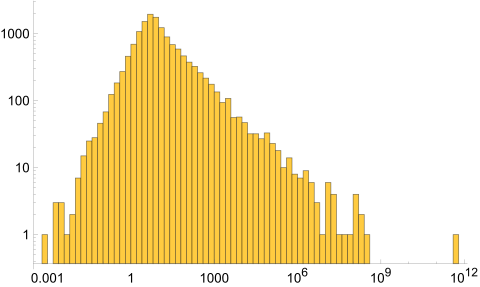
We are able to identify a clear peak in energy distribution at around $10 \mathrm{TeV}$, and fit a power-law distribution to the tail, which suggests the coefficient $\alpha$ is approximately $0.5$. This is consistent with our theoretical predictions based on the HEM model, as we use papers with similar semantic masses, and the theoretical power-law scale is $\alpha=\frac 12$.